
Step 1: Choose the Right Course and Career Path
Before choosing a university, start with your career goal.
Ask yourself:
-
What career do I want after graduation?
-
Is this occupation in demand in Australia or my home country?
-
Does the course align with my academic background or experience?
Popular Courses in Australia (2026)
-
Information Technology & Data Science
-
Nursing & Allied Health
-
Engineering (Civil, Software, Electrical)
-
Social Work & Community Services
-
Business, Accounting & Project Management
-
Education & Early Childhood Studies
 Tip: Courses linked to skills shortage occupations offer better work and migration prospects.
Step 2: Research and Select Australian Institutions
Australia has:
-
Universities
-
University Colleges
-
TAFEs (Technical and Further Education)
-
Private Colleges
When comparing schools, consider:
-
Tuition fees
-
Entry requirements
-
Course duration
-
Location (city vs regional)
-
Graduate outcomes
Key Documents to Review
-
Course handbook
-
Entry requirements
-
English language criteria
-
Work-integrated learning or placements
Step 3: Check Academic and English Requirements
Academic Requirements
These vary by level:
-
Diploma/Bachelor: Secondary school certificate or prior diploma
-
Master’s: Bachelor’s degree in a related field
-
Research degrees: Strong academic record + research proposal
English Language Tests Accepted
-
IELTS
-
PTE Academic
-
TOEFL iBT
-
Cambridge English
Each institution sets its own minimum score. Some pathways or diplomas may accept lower scores.
Step 4: Prepare and Submit Your Application
You’ll typically need:
-
Academic transcripts and certificates
-
English test result
-
Passport bio-data page
-
CV (for postgraduate courses)
-
Statement of Purpose / Personal Statement
-
Portfolio (for design or creative courses)
Once submitted:
-
Universities assess your application
-
You may receive an Offer Letter (conditional or unconditional)
Step 5: Accept Your Offer and Receive Your CoE
After accepting your offer:
-
Pay required tuition deposit
-
Meet all conditions
-
Receive your Confirmation of Enrolment (CoE)
The CoE is a mandatory document for your student visa application.
Step 6: Understand the Australian Student Visa (Subclass 500)
-
Valid CoE
-
Genuine Student (GS) statement
-
Financial capacity
-
Overseas Student Health Cover (OSHC)
-
English proficiency
-
Health and character checks
Work Rights
-
Up to 48 hours per fortnight during study
-
Unlimited hours during scheduled breaks
Step 7: Write a Strong Genuine Student (GS) Statement
The GS statement explains:
-
Why you chose Australia
-
Why this course and institution
-
How the course fits your background
-
Your career plans after graduation
-
Ties to your home country
A strong GS statement is:
-
Personal and truthful
-
Career-focused
-
Well-structured
-
Consistent with your documents
 Avoid copying templates or generic answers—this is a common reason for refusals.
Step 8: Prove Financial Capacity
You must show funds for:
-
Tuition fees
-
Living expenses
-
Travel costs
Acceptable evidence may include:
-
Personal savings
-
Parent or spouse sponsorship
-
Business income
-
Education loans
-
Scholarships
Funds must be genuine, traceable, and consistent.
Step 9: Arrange Overseas Student Health Cover (OSHC)
OSHC is compulsory for all international students.
It covers:
-
Doctor visits
-
Hospital treatment
-
Prescription medicine
-
Emergency care
Your OSHC must cover the entire duration of your visa.
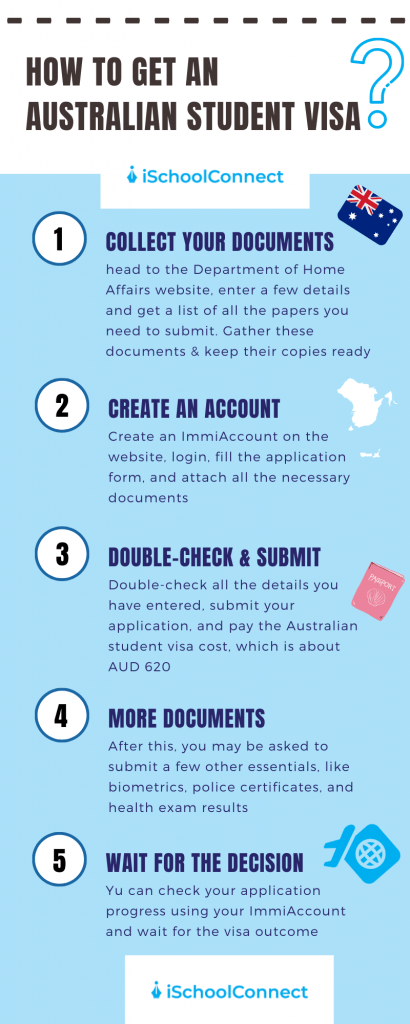
Step 10: Apply for Your Student Visa
Once all documents are ready:
-
Lodge your application online
-
Pay the visa application charge
-
Attend biometrics (if required)
-
Complete medical examinations
Processing times vary based on:
-
Country of application
-
Course level
-
Completeness of documents
Step 11: Prepare for Life in Australia

-
On-campus housing
-
Shared apartments
-
Homestay
-
Private rentals
Cost of Living (Average)
-
Accommodation: AUD 150–350/week
-
Food: AUD 80–150/week
-
Transport: AUD 30–60/week
Step 12: Working While Studying in Australia
Most students work part-time in:
-
Retail
-
Hospitality
-
Aged care
-
Cleaning
-
Administration
-
Support roles related to their field
Working helps:
-
Support living expenses
-
Build local experience
-
Improve employability after graduation
Step 13: Graduate Pathways & Post-Study Work
After graduation, eligible students may apply for the:
-
Temporary Graduate Visa (Subclass 485)
This allows:
-
2–4 years of full-time work (depending on qualification)
-
Opportunity to gain Australian work experience
-
Potential transition to skilled or employer-sponsored visas
Step 14: From Study to Skilled Migration
Australia values:
-
Australian qualifications
-
Local work experience
-
Skills in demand
-
English proficiency
Possible pathways include:
-
Skilled Independent visas
-
State nomination
-
Employer sponsorship
-
Regional migration options
Common Mistakes to Avoid
-
Choosing a course with no career relevance
-
Submitting weak GS statements
-
Using inconsistent financial documents
-
Applying without professional guidance
-
Ignoring visa conditions
Is Studying in Australia Worth It in 2026?
Yes ! if done correctly.
Australia offers:
-
Quality education
-
Real work opportunities
-
Clear post-study pathways
-
Global career recognition
However, success depends on proper planning, honest documentation, and strategic course selection.
Need Professional Help?
If you want:
-
Course and university selection
-
Strong GS statement writing
-
Student visa application support
-
Study-to-work migration planning
 Our team specialises in Australian student and work visa pathways and can guide you every step of the